Kitchen power point installation is one of the most detail-intensive GPO jobs in residential electrical work. You are dealing with tight tolerances above bench surfaces, multiple appliance circuits, splash zone requirements, and clients who will notice every millimetre of inconsistency.
This guide covers the height and spacing standards for kitchen GPOs, the safety requirements near sinks and water sources, and how to plan and execute a kitchen power point installation that meets AS/NZS 3000.
Bench Height: The Standard and Why It Matters
The accepted industry standard for kitchen power points is 150–200 mm above the finished benchtop surface. With a standard 900 mm bench, this puts the centre of the outlet at roughly 1,050–1,100 mm above the floor.
The critical reference point is the finished benchtop surface — not the carcass or the floor. On renovation jobs where the bench is not yet installed, confirm the bench height with the cabinetmaker before rough-in. A non-standard bench (e.g. 850 mm for accessible design) shifts your GPO height accordingly.
Spacing Kitchen GPOs Correctly
Industry practice is to provide at least one double GPO per 900 mm of continuous benchtop run. This ensures an appliance can always be reached by a standard cord without needing an extension lead.
For a typical 3,600 mm bench run, plan for four double GPOs — one at roughly every metre. Additional GPOs to plan for:
- Rangehood — dedicated circuit, positioned above the hood
- Dishwasher — usually under-bench, often hardwired
- Refrigerator — dedicated circuit recommended
- Microwave — above-bench or in an appliance cabinet
Safety Near the Sink
Industry practice for kitchen sink clearance:
- Maintain at least 300 mm horizontal clearance from the sink basin
- Do not position a GPO directly above the sink
- Where a double sink is involved, measure clearance from the nearest sink edge
- All kitchen GPOs must be RCD protected
Island Bench Installations
- Both sides accessible — Plan for back-to-back GPOs or outlets on multiple faces
- Floor or ceiling cable entry — Confirm the cable route before the slab is poured or the ceiling is closed
- Height consistency — Breakfast bars often have a raised bench (1,050–1,100 mm). GPO height is measured from the bench surface, not the floor
- Pop-up outlets — A popular option for island benches. Confirm product dimensions before marking
RCD Requirements in Kitchens
All socket outlets in domestic and residential buildings must be RCD protected under AS/NZS 3000 — no exceptions. For new kitchen installations, RCD protection is typically provided by RCD circuit breakers at the switchboard. For alterations to existing kitchens, confirm whether existing circuits are already RCD protected before connecting new outlets.
Planning a Kitchen Power Point Layout
Before rough-in, confirm:
- Bench height and material (affects finished surface height)
- Appliance locations (dishwasher, rangehood, fridge, microwave)
- Island bench dimensions and cable route
- Any in-cabinet GPO requirements
- Client preferences for number and location
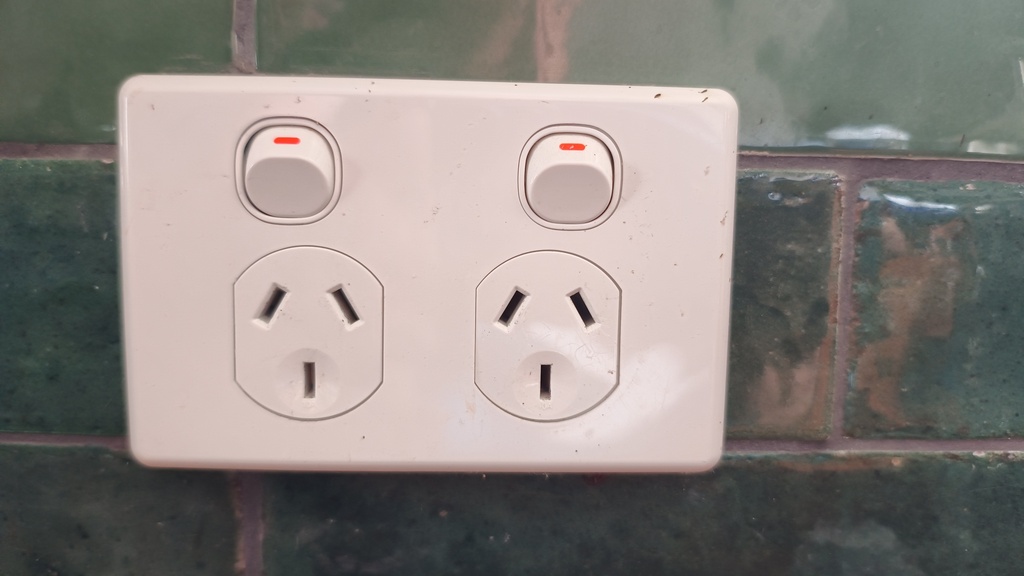
Getting Consistent Results with a Marking Template
On a kitchen bench run with six or eight GPOs, using a precision marking template is the fastest way to get consistent, accurate cut-outs on every outlet. Set your reference height above the bench surface, position the template, check level, and trace. Eight identical, perfectly-sized cut-outs in a fraction of the time.
The PowerpointMate Standard Series Plate and Slimline Series Plate are purpose-built for Australian GPO installation. Shop PowerpointMate — $25 AUD

Frequently Asked Questions
- How high should power points be above a kitchen bench?
- Kitchen power points should be installed 150-200 mm above the finished benchtop surface. With a standard 900 mm bench, this places the outlet at approximately 1,050-1,100 mm above the floor.
- How far from the sink should a power point be in a kitchen?
- Maintain at least 300 mm horizontal clearance from the sink basin. In practice, most electricians position kitchen GPOs well away from the sink to avoid any splash risk.
- How many power points should a kitchen have?
- Industry practice recommends at least one double GPO per 900 mm of benchtop run. A modern kitchen with an island will typically require 6-10 GPOs in total.
- Do kitchen power points need RCD protection?
- Yes. All socket outlets in domestic and residential buildings, including kitchens, must be RCD protected under AS/NZS 3000.
- Can I install a power point inside a kitchen cabinet?
- Yes. In-cabinet GPOs are common for appliance garages and integrated appliances. They must still meet height and RCD requirements, and cable entry must be properly protected.
- What is the best marking tool for kitchen power point installation?
- A precision GPO marking template like the PowerpointMate Standard or Slimline Series Plate lets you mark consistent, accurate cut-outs across every bench run without re-measuring each time.